Why Everyone Is Suddenly Wearing AI Smart Glasses
Meta's new $299 frames and its display glasses turned a nerdy experiment into the gadget of the year.
Adaptive lights brighten as you approach and fade when the street empties, cutting power bills and giving back the stars.
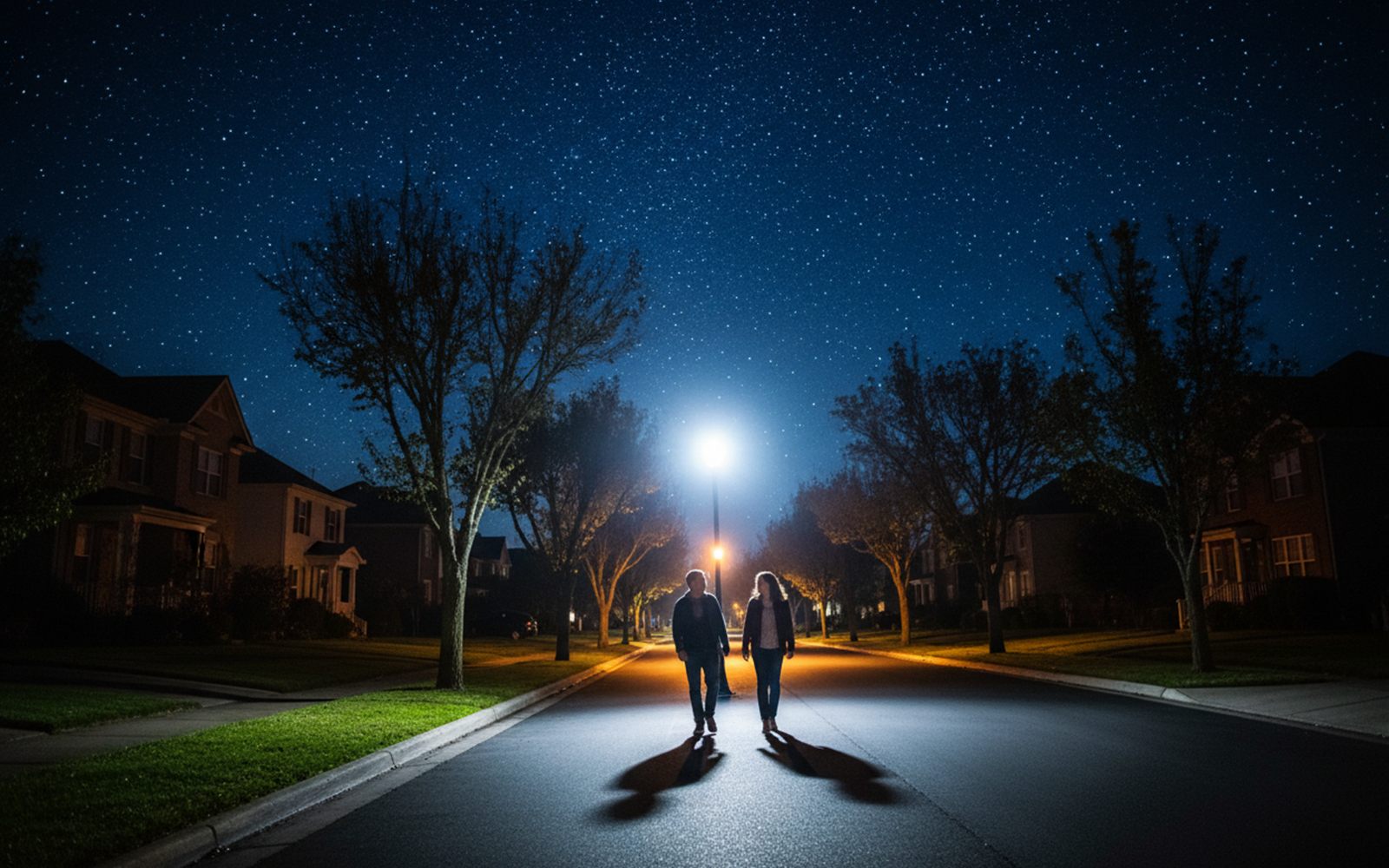
Walk a quiet street after midnight in Tucson and you may notice something odd about the light. It is dimmer than you remember. Not dark, not gloomy, just turned down, the way you would turn down a radio in an empty room.
That is on purpose. The city put nearly 20,000 streetlights on a control system that runs them at about 90 percent brightness in the evening and drops them to 60 percent after midnight, when almost nobody is out.
Tucson approved the plan in February 2016 and finished the conversion in 2018, swapping old orange sodium lamps for LEDs with adaptive controls. The city projected roughly a 70 percent cut in lighting energy, and researchers with DarkSky International used the whole city as a giant experiment, measuring the sky from above while the lights were deliberately dimmed.
Other cities went bigger. Chicago modernized 280,000 streetlights and saved $8.7 million in a single year after cutting streetlight energy use in half. San Diego ran adaptive control pilots in eight test areas. Los Angeles put 104 solar smart lights into Van Nuys and committed to roughly 900 more.
It is still early. Around 30 of the 500 largest US cities have deployed smart streetlight systems, with another 48 piloting or seriously considering them. Abroad the rollouts are much larger. India’s Andhra Pradesh state began phase two of its program this April, connecting 750,000 streetlights to a central management system.
Each pole gets a small radio controller, and sometimes a motion or traffic sensor. A central system tells the lights how bright to be by time of night, by street, or by whether anything is actually moving on the block.
Think of it as a dimmer switch for the whole city, with a schedule and a pair of eyes.
It is your money. Streetlights are one of the biggest single line items in a city’s power bill, and adaptive dimming trims consumption another 10 to 20 percent beyond the LED savings alone, with well tuned systems reaching much further.
It is your sleep and your view. Light that spills sideways into bedroom windows and upward into the sky is wasted light. Turning it down after midnight gives back some of the night, and in Tucson the measured skyglow dropped.
And it is your safety, done more precisely. Adaptive systems can push brightness up where people actually are, so crosswalks and intersections get more light at the moment a person steps into them rather than at 3 am on an empty block.
Dimming makes people nervous, and cities have learned to keep minimum levels on intersections, crosswalks and high traffic corridors rather than dropping everything uniformly.
The bigger sticking point is the pole itself. Once a light has a radio, cities get tempted to hang sensors and cameras on it, and San Diego’s earlier camera equipped streetlights set off a privacy fight that ended with the cameras switched off. Any program worth supporting says out loud what the poles collect and what they do not.
This is the part worth knowing before your next council meeting, because the evidence points two directions and both are real.
Better lighting does reduce crime. A randomized experiment in New York City, run with the University of Chicago Crime Lab, found that adding lighting cut nighttime outdoor index crimes by at least 36 percent. A two year study of a large LED conversion published last year found a 15 percent decline in outdoor street crime at night. A separate analysis of Mesa, Arizona’s retrofit found the drop came from theft and low level offenses, with no measurable change in violent crime.
Turning lights off is a different move. A British study of towns that switched lighting off entirely after midnight to save money found crime rose on the street segments next to the dark ones.
That distinction is the whole argument. Dimming a well shielded LED from 100 percent to 60 percent leaves a lit street. Switching it off leaves a dark one. Research backed by the Department of Energy has found adaptive systems can cut lighting energy by more than half while reducing light trespass and skyglow, which is only true if the lights stay on and simply stay lower.
Ask which one your city is buying.
Watch your city council agenda for the words adaptive controls or smart lighting, usually attached to an LED conversion contract. Vendors including Itron and Current Lighting now sell the control layer as a package, which is why these projects have started moving faster than they did five years ago.
If your street is getting new LEDs, that is the moment to ask whether they dim, and whether they are shielded to point down.
The smartest thing a streetlight can do, it turns out, is mind its own business when nobody is there.
Meta's new $299 frames and its display glasses turned a nerdy experiment into the gadget of the year.
After a decade of promises, solid state cells are shipping in a real vehicle, with earbuds and cars next in line.
EarFun's Clip 2 puts live translation in 100 languages on your ears without a triple digit price.