Why Everyone Is Suddenly Wearing AI Smart Glasses
Meta's new $299 frames and its display glasses turned a nerdy experiment into the gadget of the year.
Concrete seeded with limestone making bacteria seals its own cracks, and 2026 brings its biggest road tests yet.
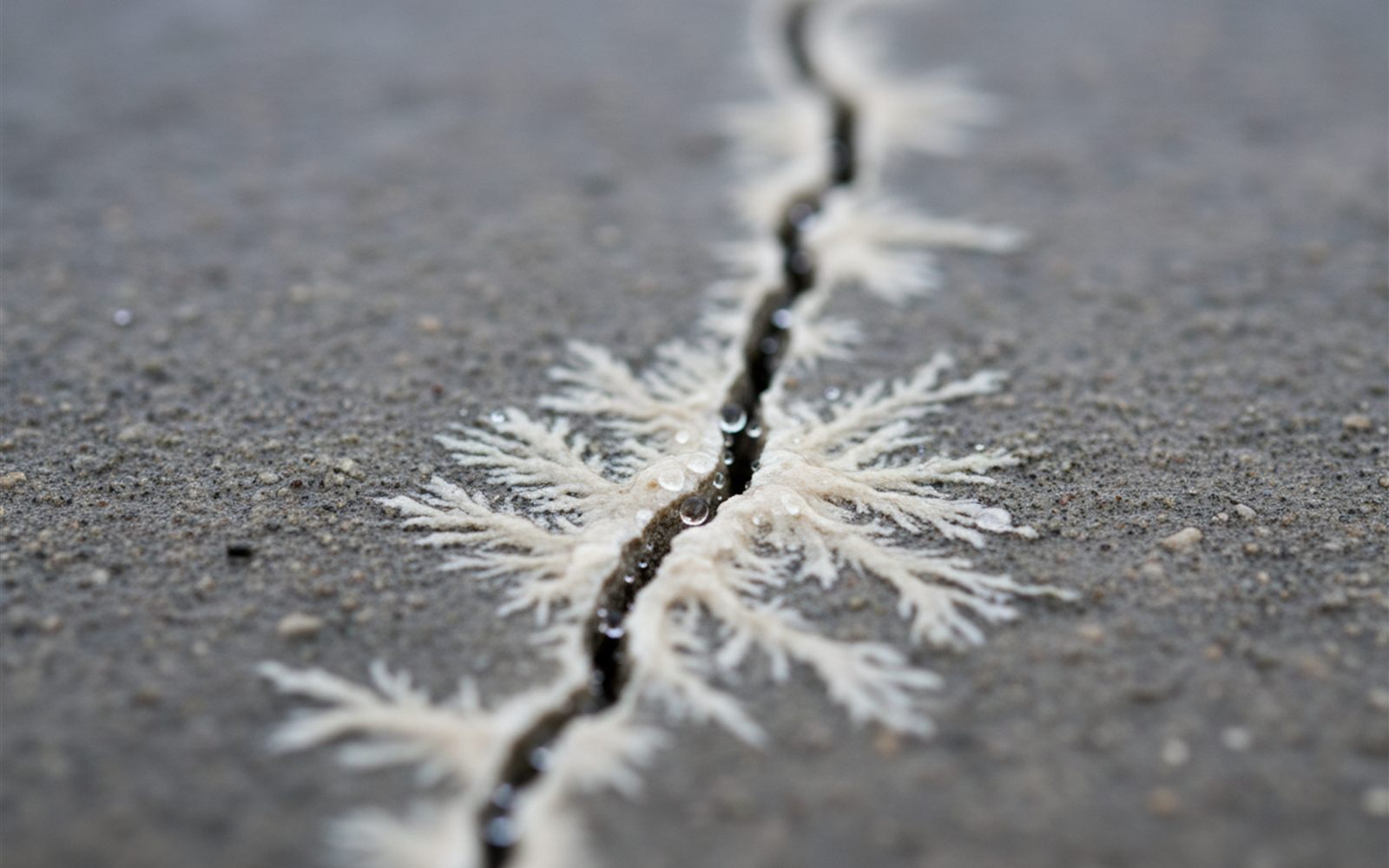
Every crack in a sidewalk is a repair bill that has not arrived yet. In the Netherlands, some new concrete has started answering those bills itself, by growing its own patches.
Green Basilisk, a company spun out of Delft University of Technology, sells concrete and mortar seeded with dormant, limestone producing bacteria. The idea has now left the lab in a serious way. Basilisk and Dutch builder Heijmans have a 2026 pilot on a highway viaduct, tracking how cracks close under the vibration of heavy truck traffic, while researchers in Lithuania are scaling a bridge beam study up to a 30 meter pedestrian span. Tech outlet BGR reports the material is being used in projects in the US as well. Basilisk sells the system both as granules mixed into fresh concrete and as repair mortars, so structures already standing can get the biology too.
Think of it as a scab for pavement. Mixed into the concrete are bacterial spores and their packed lunch, a calcium compound. When a crack forms and rain seeps in, the water wakes the spores. They eat, and their waste product is calcium carbonate, essentially limestone, which fills the crack solid within weeks. Then the bacteria go dormant again, waiting for the next crack. The spores can sit sealed in their capsules for years before that day ever comes.
Modern engineers are not the first to pour concrete that repairs itself. In 2023, researchers at MIT and Harvard solved a two thousand year old mystery: the small white mineral flecks in Roman concrete, long dismissed as sloppy mixing, were actually the healing system. The Romans mixed in raw quicklime, and every fleck it left behind became a tiny repair kit. When a crack forms and rainwater reaches a fleck, calcium dissolves into the water and then hardens into calcium carbonate, sealing the gap shut. In lab tests, concrete made the ancient way healed its cracks completely once water flowed through, while modern style control samples never did.
Today’s bacterial concrete is the same trick with a different worker, spores instead of quicklime, and the endgame is identical: a material that treats water, the very thing that kills concrete, as the trigger for its own repair. The stakes reach past potholes, too. Coverage of the MIT work notes that cement production accounts for about 8 percent of global greenhouse gas emissions, so concrete that lasts decades longer is one of the quietest climate wins on the table.
Fewer orange cones. Roads and bridges that seal their own hairline cracks need fewer repair closures, which is time you never spend idling in a work zone detour.
Structures last longer before the big bills arrive. Water sneaking through cracks is what rusts the steel inside concrete, and rusting steel is what actually kills bridges, parking decks, and driveways. Seal the water out early and the expensive failure gets postponed by years.
The tax math improves too. Pouring concrete costs roughly $65 to $150 per cubic meter, but keeping US highway concrete patched averages about $147 per cubic meter over its life, nearly the price of the material all over again. Research on self healing mixes points to 40 to 50 percent less maintenance.
The bacteria handle hairline cracks, not potholes or structural failures, and the mix costs more up front. That is why it targets hard to repair structures first, think tunnels, basements, bridge decks, and viaducts, where every repair visit is expensive and disruptive. Long term, decade scale proof is still accumulating, which is precisely what the Heijmans viaduct pilot is designed to deliver.
Public works agencies are the customers to watch, because they own the repair bills, and concrete is the most used building material on Earth, so even modest percentage savings on upkeep add up to real money for cities. Market analysts project self healing concrete growing into a $1.14 billion market by 2033, roughly seven times today’s size, as pilot projects turn into standard procurement. Every successful viaduct makes the next city’s decision easier.
The best road repair crew of the 2030s may be microscopic, already inside the pavement, and just waiting for rain.
Meta's new $299 frames and its display glasses turned a nerdy experiment into the gadget of the year.
After a decade of promises, solid state cells are shipping in a real vehicle, with earbuds and cars next in line.
EarFun's Clip 2 puts live translation in 100 languages on your ears without a triple digit price.