
Why Everyone Is Suddenly Wearing AI Smart Glasses
Meta's new $299 frames and its display glasses turned a nerdy experiment into the gadget of the year.
Phones that unfold into tablets and laptops with screens that roll out on demand are finally real.

The person at the next gate pulls out a normal looking phone, unfolds it once, then unfolds it again. Suddenly they are holding a 10 inch tablet that came out of a jacket pocket. In 2026, that little magic trick is a real product you can buy.
Samsung announced the Galaxy Z TriFold on December 1, 2025 and put it on sale in the United States on January 30, 2026 for $2,899. Closed, it works as a regular 6.5 inch phone. Open it twice and the screen grows to 10 inches, roughly iPad territory, with a big 5,600 mAh battery to feed it. It runs the same Snapdragon 8 Elite chip as Samsung’s regular flagships, so nothing about it feels like a science project.
Huawei got there first. Its Mate XT line has been folding twice since 2024, and the newest Mate XTs sells in China for roughly $2,550 and up, opening into a 10.2 inch display. Demand has surprised the skeptics, too. Supply chain analyst Ming Chi Kuo raised shipment estimates for Huawei’s tri fold line to roughly a million units, remarkable for a phone that costs as much as a used car.
Screens that roll are shipping too. Lenovo’s ThinkBook Plus rollable laptop has a 14 inch display that motors upward into a 16.7 inch portrait screen at the press of a button.
These are flexible OLED panels built on thin plastic layers instead of rigid glass, so they bend like the cover of a paperback. The hinge tucks the screen into a gentle teardrop shape rather than creasing it flat, which is why Samsung rates its folding screens for hundreds of thousands of folds.
The crease is the first question everyone asks and the first thing owners stop noticing. You can find it with a fingertip, and you can see it with the screen off, but with a video playing it disappears within a day of ownership. What owners notice instead is the weight, since a tri fold carries two hinges and a bigger battery, and the party trick of setting the half opened phone on a table like a tiny laptop for a video call.
The habit that sticks is three apps at once. Flight details, the group chat, and the boarding pass all stay visible on one 10 inch canvas, which is the moment the price starts making a strange kind of sense to the people who paid it.
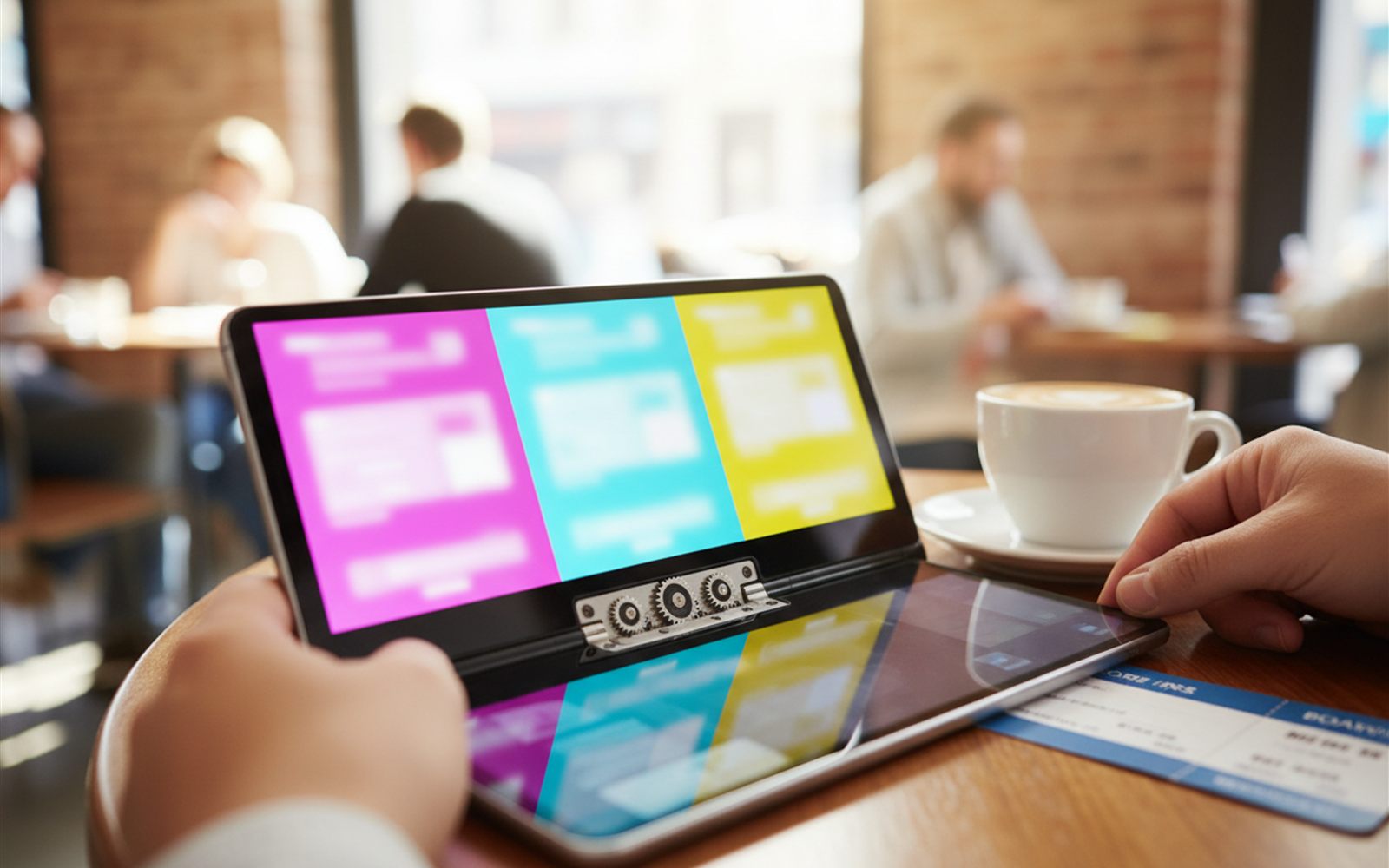
One device can now cover three jobs. It is a phone in the checkout line, a tablet for the flight, and, propped open with a keyboard, a passable little laptop for email.
Multitasking stops feeling cramped. A 10 inch canvas fits three full apps side by side, so the game, the group chat, and the recipe can all stay open.
And every gadget you no longer pack is weight out of your bag and one less charger to forget. Frequent flyers and commuters are the obvious first adopters, but the same trick matters to anyone who reads, sketches, or edits documents away from a desk.
Foldables now run from impulse purchase to small used car. Here is the field after Samsung’s July announcements.
| Device | Price | What it is |
|---|---|---|
| Motorola Razr | from about $699 | the affordable flip that made folding normal |
| Samsung Galaxy Z Flip 8 | from $1,199 | the polished flip, announced July 22 |
| Samsung Galaxy Z Fold 8 | from $1,899 | phone that opens into a small tablet |
| Samsung Galaxy Z Fold 8 Ultra | from $2,099 | the spec maxed book style fold |
| Samsung Galaxy Z TriFold | $2,899 | the double fold, a 10 inch tablet in a pocket |
Foldables are the only part of the phone market that is actually growing fast. Counterpoint Research forecasts global foldable shipments up about 21 percent in 2026, to roughly 24 to 25 million units, while IDC projects as much as 30 percent growth for the year. Both firms cite the same catalyst: Apple’s long expected first folding iPhone, which IDC expects late in 2026 and projects could take more than a fifth of the market almost immediately.
Zoom out and the split is stark. Counterpoint pegs foldables growing about 17 percent a year through 2029, versus roughly flat for regular smartphones. Screens that bend are where the industry’s ambition went.
Prices have not fallen yet at the top. At $2,899 the TriFold costs as much as a very nice laptop, and PhoneArena reports Samsung treated it as a limited run that was gone from shelves by spring. Tri fold phones are also heavier than regular phones, the crease never fully disappears, and some apps still do not know what to do with a nearly square screen.
The affordable end of bendable screens is the flip phone. Motorola’s Razr line starts around $699, a preview of where folding prices head once a design matures.
The next chapter already started. At its July 22 Unpacked event in London, Samsung introduced the Galaxy Z Fold 8 at $1,899, a spec heavy Fold 8 Ultra at $2,099, and the Flip 8 at $1,199, its most complete folding lineup yet. With Apple expected to join within months and Chinese brands racing on tri folds, every new entrant pushes prices closer to a real fight, which is historically the moment a luxury gadget becomes a normal one. The pocket computer is sprouting new shapes in every direction this year, from screens that fold to glasses that put the screen on your face.
The next time someone unfolds a full tablet out of a jacket pocket at your gate, you will know it is not a magic trick. It is just 2026.
Meta's new $299 frames and its display glasses turned a nerdy experiment into the gadget of the year.
After a decade of promises, solid state cells are shipping in a real vehicle, with earbuds and cars next in line.
EarFun's Clip 2 puts live translation in 100 languages on your ears without a triple digit price.