Why Everyone Is Suddenly Wearing AI Smart Glasses
Meta's new $299 frames and its display glasses turned a nerdy experiment into the gadget of the year.
Walmart, Amazon, and Zipline now drop groceries and medicine at millions of doorsteps in about 30 minutes.
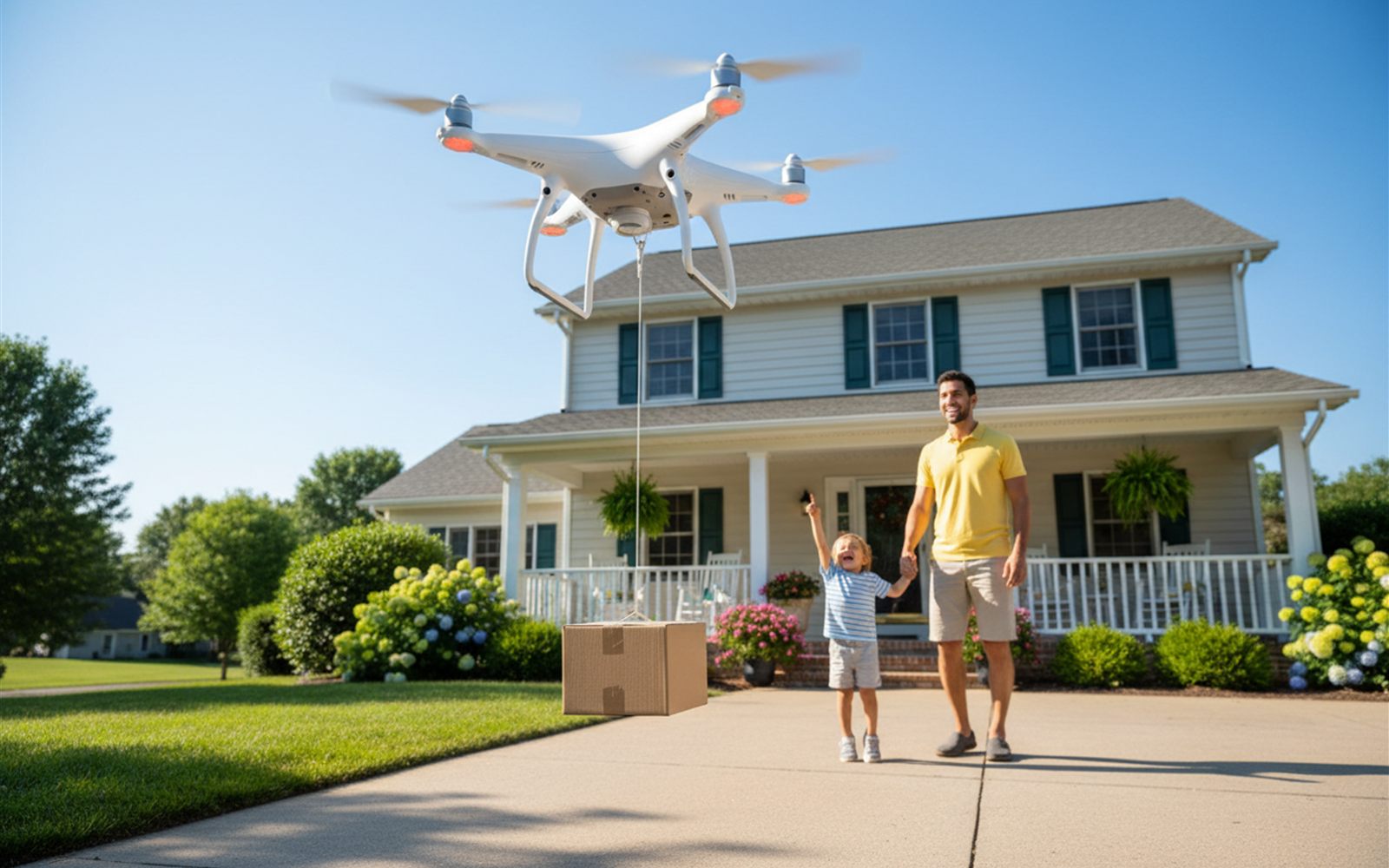
That soft buzz over the backyard is not a hobby drone. It is somebody’s groceries. While almost nobody was paying attention, drone delivery crossed from demo to daily habit across a long list of American suburbs.
Zipline, the quiet leader, has passed 1 million deliveries and more than 100 million autonomous miles, and this year it switched on service in Houston and Phoenix with roughly $600 million in fresh funding behind it. In January, Walmart and Alphabet’s Wing announced plans to add drone delivery at 150 more stores, taking Wing past 270 locations on a path toward reaching about 60 million US households. Amazon’s Prime Air now flies in Arizona, Florida, Kansas, Michigan, and Texas, handles more than 5,000 deliveries a week, and in May named metro Atlanta as a next stop. In the Dallas Fort Worth area, the earliest big battleground, drone delivery already reaches a majority of households.
You order on an app, and a drone flies itself to your address a few hundred feet up, then hovers and lowers the package on a tether or releases it gently over your yard. Zipline’s newest system is the clever one: the drone waits high overhead while a small tethered carrier descends and sets the package on a doormat sized target. Most flights finish in 15 to 30 minutes. The quiet unlock was regulatory: the FAA now permits flights beyond the operator’s line of sight, so one launch site can serve entire zip codes instead of a few blocks.
The first one turns the whole household into spectators. You place the order in the Walmart or Wing app the way you would any pickup order, except a drone option appears at checkout because your address sits inside the flight zone. Workers pack the items into a special lightweight box, clip it under the aircraft, and the app starts a countdown that reads more like a flight tracker than a pizza timer.
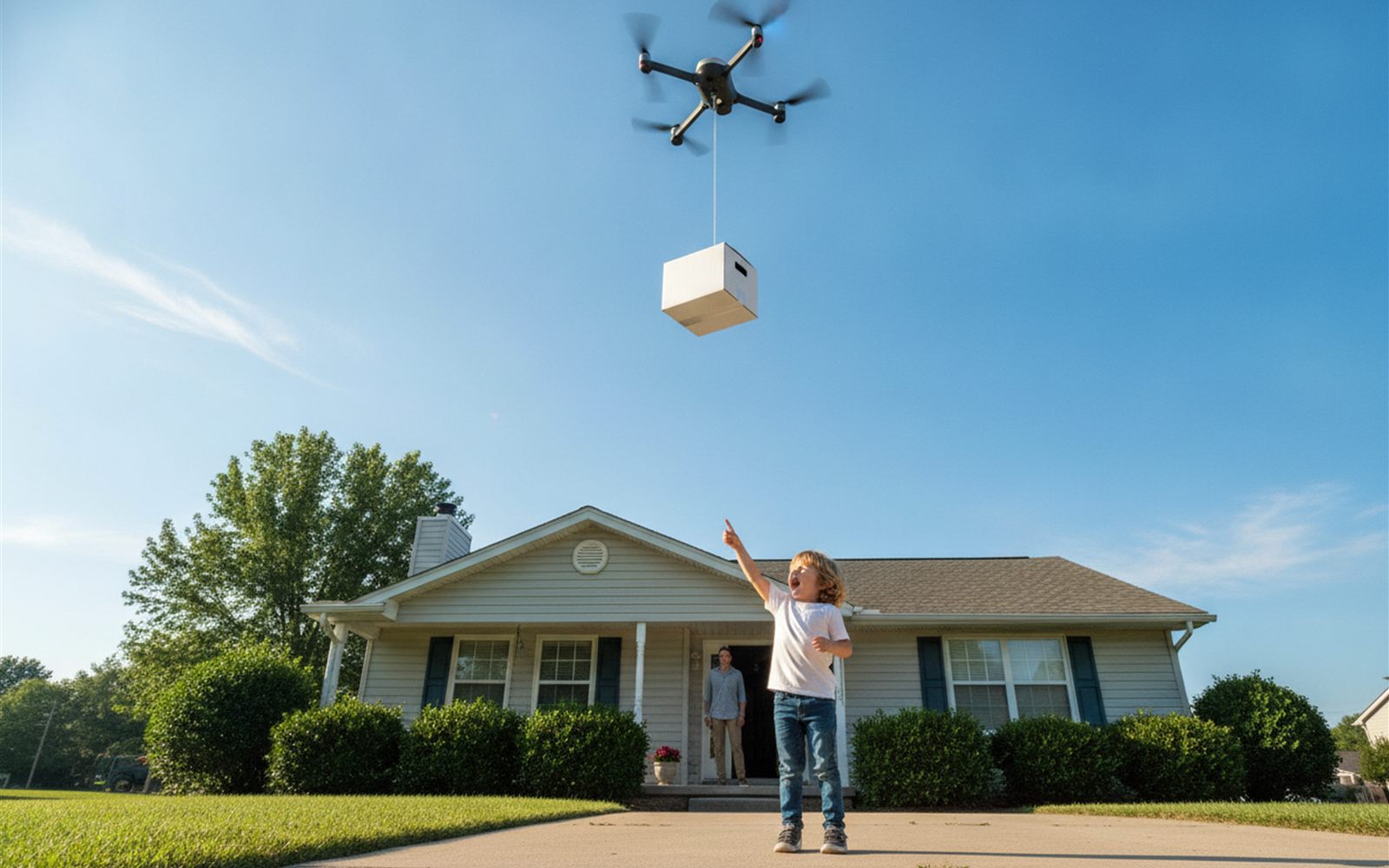
Then comes the sound, a soft weed whacker hum that grows for about twenty seconds. The drone slides into view above the driveway and stops, hovering seventy feet or so overhead. It does not land. A thin tether spools the box down while the aircraft holds almost perfectly still, the package touches the grass, the line releases on its own, and the drone climbs away toward the horizon. The entire visit lasts under a minute, and Wing says its average Walmart order arrives in under 19 minutes from click to grass.
The second delivery, owners report, is different mainly because nobody bothers to come outside anymore. That is the real milestone: the moment the flying robot becomes as unremarkable as the mail truck.
Three networks cover most of the map, with a fourth just joining.
| Service | Where it flies | The specialty |
|---|---|---|
| Walmart with Wing | Dallas Fort Worth plus Atlanta, Charlotte, Houston, Orlando, and Tampa, with seven more markets named in June | groceries and small essentials from the Walmart app |
| Amazon Prime Air | parts of Arizona, Florida, Kansas, Michigan, and Texas | everyday Amazon items in an hour or less |
| Zipline | Houston, Phoenix, and Walmart sites in Arkansas and beyond | pharmacy and grocery drops with its quiet lowering droid |
| DoorDash | first US markets this summer | restaurant orders, newly in the air |
DoorDash is the newest name on the list: industry site The Drone Girl called late July a watershed week as DoorDash’s drone service and partner Flytrex expanded alongside the big three. When the food apps show up, a technology has officially left the pilot phase.
The growth stopped being subtle this spring. Walmart announced in May that it had crossed 1 million cumulative drone deliveries, with more than 200,000 of them in Texas alone, flying from 66 stores across four states. Wing says overall deliveries tripled in the past six months, and its heaviest users are not dabbling: the top quarter of customers order about three times a week.
Meanwhile Zipline’s million plus deliveries and 100 million autonomous miles came with a safety record strong enough that hospitals and pharmacies were its first customers, years before the pasta sauce crowd showed up. Add Amazon’s 5,000 plus weekly flights and the picture is clear: this is compounding, not experimenting.
If it feels like drone delivery arrived overnight, it actually took thirteen years of slow permission slips. Jeff Bezos promised it on 60 Minutes back in December 2013, to open laughter, and Amazon managed its first customer drop in England in December 2016. Wing became the first drone operator certified as an actual airline by the FAA in 2019. But the real bottleneck was the rule that a human had to keep every drone in eyesight, which limited service to a few blocks of showcase suburb. The waivers that let drones fly beyond the operator’s view, granted widely only in the last few years, are the whole reason your zip code is suddenly on a coverage map. The technology waited a decade for paperwork, and the paperwork finally cleared.
Payloads run roughly two to eight pounds depending on the company, and that covers more of life than you would think: prescriptions, eggs, ice cream, phone chargers, batteries, baby wipes, the forgotten jar of pasta sauce. Walmart’s drone menus lean heavily on exactly these small emergencies.
If your address qualifies, the first order takes five minutes of setup. Check your address in the Wing, Zipline, or Prime Air app, pick a drop spot with clear sky, a driveway or an open patch of yard the size of a beach towel, and keep the dog inside for the delivery window. The apps walk you through all of it with a satellite photo of your own house.
Sick day medicine arrives without anyone leaving the couch. The missing dinner ingredient shows up in the time it takes to boil the pasta. And for households far from town, half hour delivery is arriving years before any van based service would have bothered.
There is a quieter winner too: anyone stuck home with a sleeping baby, a broken ankle, or no car in the driveway, for whom a few dollar flight fee beats begging a favor or paying for a ride to the store.
The complaints that follow the drones are consistent: noise and privacy. The hum is real, though it lasts under a minute per visit, and the companies have spent heavily on quieter propellers precisely because early test towns grumbled. Zipline’s whole two part design, aircraft high above, small droid descending, exists largely to keep the noise and the cameras far from your window. The drones navigate with downward sensors, and the operators say imagery is used for navigation and delivery confirmation, but a camera overhead is still a camera, and skeptical neighbors have a point worth respecting.
There is also the sky clutter question: what happens when four companies fly the same suburb? The FAA’s answer so far is strict corridors, altitude separation, and approval gates that only a handful of operators have cleared. Zipline, for its part, says its million plus deliveries and 100 million miles have come without a serious injury, the statistic these companies repeat most because it is the one that matters most.
Walmart and Wing keep switching on new stores through 2026, Zipline is targeting at least four states this year, and Amazon’s Atlanta expansion is coming. Industry site DroneXL notes Georgia’s skies are already busy with Walmart and Wing flights before Amazon even shows up, a sign of how fast the race is compounding.
By 2028, if the announced buildouts hold, drone range should cover tens of millions of households, and the choice at checkout will read like shipping speeds do today: tomorrow, today, or twenty minutes by air. The sky is quietly becoming infrastructure, the same shift that now lets an ordinary phone text through satellites when the towers disappear.
The delivery van is not going anywhere, but for everything under five pounds, the sky just became a shipping lane.
Meta's new $299 frames and its display glasses turned a nerdy experiment into the gadget of the year.
After a decade of promises, solid state cells are shipping in a real vehicle, with earbuds and cars next in line.
EarFun's Clip 2 puts live translation in 100 languages on your ears without a triple digit price.