
Why Everyone Is Suddenly Wearing AI Smart Glasses
Meta's new $299 frames and its display glasses turned a nerdy experiment into the gadget of the year.
Home storage has quietly gotten cheap, easy to plug in, and in some states it pays you back every summer.
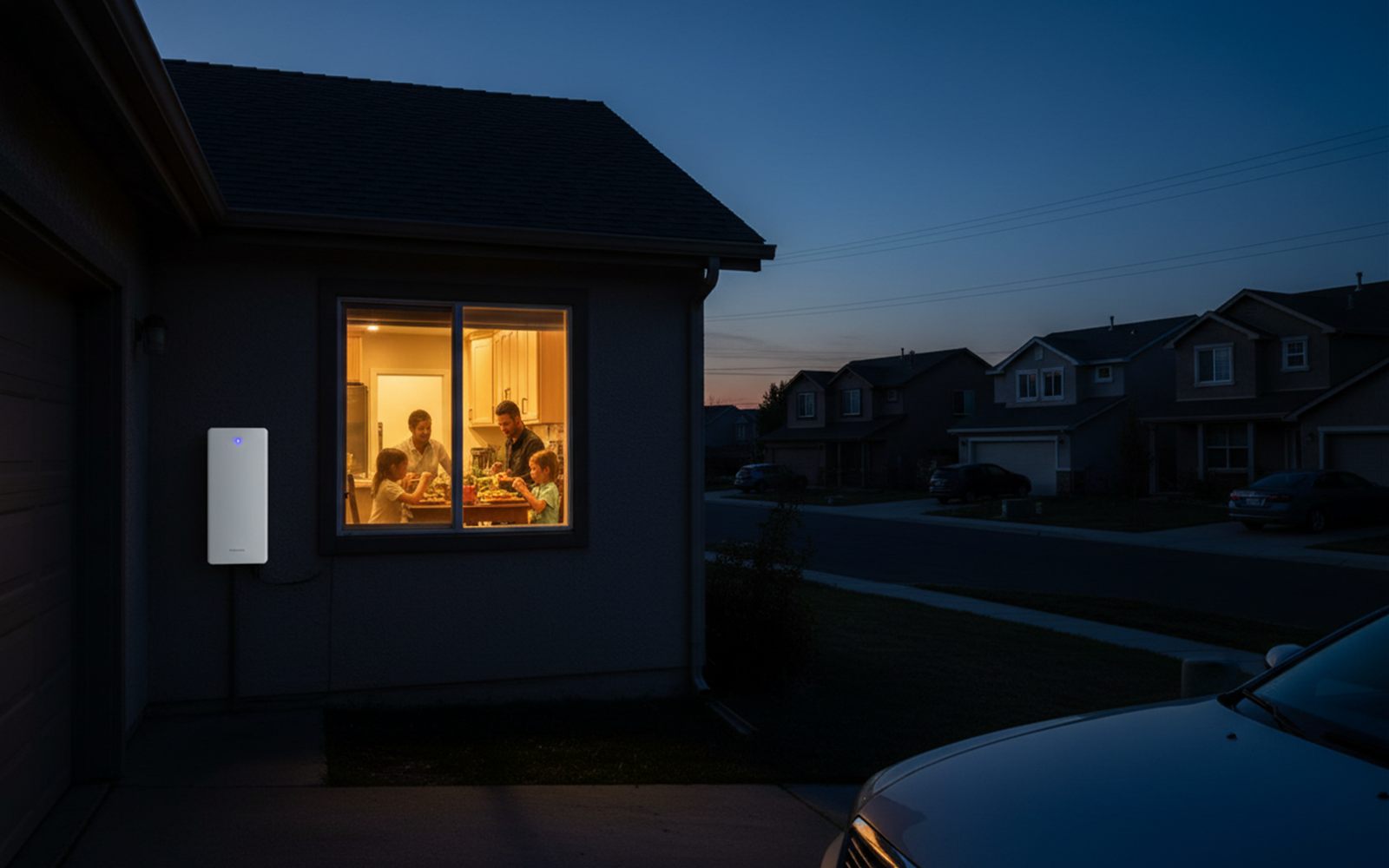
The storm knocks the power out at 7:40 on a Tuesday night. Up and down the street, windows go black. In one house, the lights flicker for half a second and then carry on like nothing happened, because a box on the garage wall took over before anyone reached for a flashlight.
That box used to cost as much as a used car. It still is not cheap, but the math has changed enough that home batteries are showing up on ordinary houses, and in some states they now earn money while they sit there.
Three things landed at once.
First, prices came down. Home storage in 2026 runs roughly $700 to $1,300 per kWh, with a typical 10 to 13.5 kWh system landing between $10,000 and $16,000 fully installed, according to buying guides from EnergySage and Anker. That is a historic low for the category.
Second, the entry level got real. Anker’s Solix E10, covered by Forbes in January, starts around $4,299 for one inverter and a 6 kWh battery, and the company’s F3800 Plus bundle with an expansion battery and a home power panel sits near $4,700. Both scale up later if you want more hours of backup.
Third, the plug in category became legal. Utah passed HB 340 in March 2025 creating a category for small portable solar systems up to 1,200 watts that residents can plug into a normal outlet with no utility approval and no interconnection fee. Maine and Virginia signed their own versions in April 2026, and roughly 30 states have bills in motion.
Ask owners what the first blackout was like and most of them describe the same anticlimax: they found out from their phone.
A properly installed system throws a transfer switch in a fraction of a second, which is faster than a light bulb’s filament cools. Lamps flicker. The microwave clock survives. The television might not blink at all. Then the app sends a notification saying the grid is down and the house is running on the battery, and that notification is usually the first anyone knows.
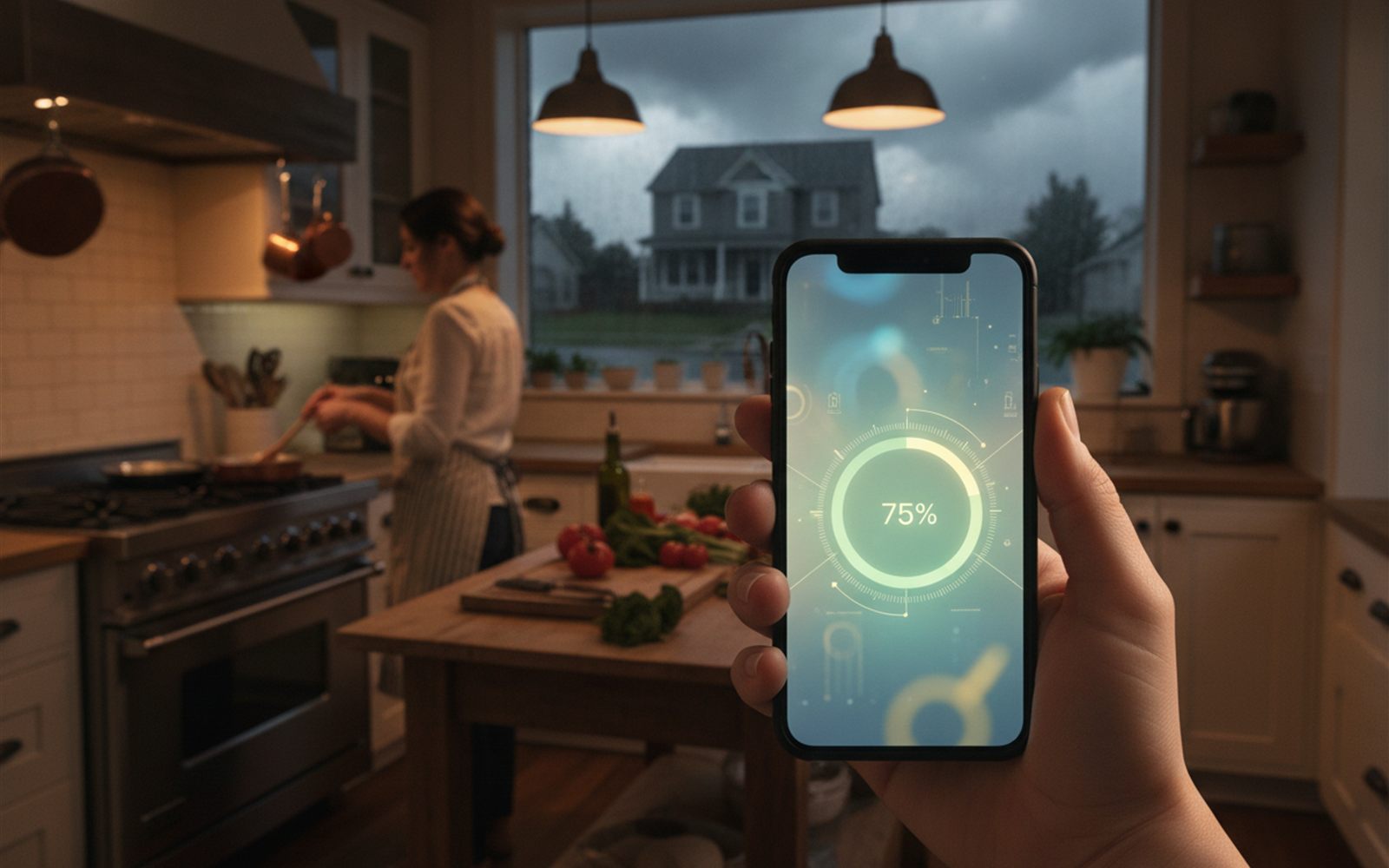
The second thing owners describe is rationing they did not expect to enjoy. The app shows hours of runtime remaining, and that number moves visibly when someone opens the oven or starts the dryer. Households learn their own power habits in one evening, which no amount of reading a utility bill ever accomplishes.
What actually stays on depends entirely on how the installer wired it. Most systems back up a chosen set of circuits: lights, outlets, the refrigerator, the internet, the furnace fan. Central air conditioning and electric ovens are the usual exclusions, because they can drain a 13.5 kWh battery in a couple of hours.
And on ordinary days, the battery does something quieter. It charges when power is cheap or the sun is up and discharges during the expensive evening window, so the machine mostly earns its keep on the 364 days nothing goes wrong.
A home battery sits between the grid and your outlets, charging when power is cheap or the sun is up and discharging when it is not. When the grid drops, an automatic switch cuts your house loose in a fraction of a second so the battery can keep the fridge, the lights, and the wifi running.
Think of it as a rain barrel for electricity. You catch it when it is plentiful and pour it out when you need it.
The obvious win is the blackout. A 10 to 13.5 kWh system comfortably covers lights, the fridge, phones, and internet through a normal outage, and larger stacks stretch that to days.
The quieter win is the check. Utilities now pay homeowners to let those batteries help the grid during peak demand, a setup called a virtual power plant. Sunrun, Tesla and Renew Home announced plans in June for a program totaling 16.8 gigawatts of that capacity.
Renters are getting options too. Startups including Pila are building plug in backup packs aimed at apartments, and Pii Energy showed a 1.2 kW solar plus 2 kWh storage system this spring designed to go up without an electrician.
This is where the category stops being a gadget and starts being an investment, and the numbers are public.
In Massachusetts, the ConnectedSolutions program paid more than $5.4 million to residential battery owners in 2025, according to pv magazine. Mass Save publishes the rate that produced those checks: roughly $275 per average kW a household contributes during summer events, which is why participating homes commonly see four figures a year rather than pocket change.
California has the deepest bench of programs, running through the state’s grid services program, the utilities, and a rebate that stacks with enrollment. Enrolled virtual power plant capacity in the state has passed 700 megawatts. Texas is the fastest mover this year, with several utilities and Base Power launching residential battery programs ahead of summer peak.
Now the number that ruins a lot of spreadsheets. The federal residential clean energy credit, Section 25D, expired at the end of December 2025. There is no federal tax credit for a standalone home battery in 2026. Anyone quoting you a payback period that includes 30 percent back from the IRS is working from last year’s math.
| System | Typical installed price | The honest role |
|---|---|---|
| Anker Solix E10 | From about $4,299 | Entry level backup, expandable later |
| Enphase IQ Battery 5P | Roughly $6,000 to $8,000 per unit | Modular, stack units for whole home |
| Tesla Powerwall 3 | Roughly $13,500 to $16,500 | The default whole home choice, strong app |
| FranklinWH | Roughly $14,000 to $17,000 | Whole home system with its own smart controller |
| Plug in balcony systems | Low four figures | A router and a lamp, not a house |
Who should buy which comes down to one question: are you buying peace of mind or a payback? If your utility runs a virtual power plant program, a bigger battery from the middle or bottom of that table can genuinely earn. If it does not, buy the smallest system that covers your fridge, your internet and your medical equipment, and stop there.
A plug in unit that fits on a balcony is a nice buffer, not whole home backup. It will keep a router and a lamp alive, not a central air conditioner.
Full backup still means a permit, an electrician, and a panel upgrade in many homes. And the payback depends heavily on your state, your utility, and whether a virtual power plant program is open to you at all.
All of it is available today. Anker, EcoFlow, Tesla and sonnen all sell to homeowners now, and a battery only virtual power plant launched in Texas this February through Solrite Energy and sonnen.
Start with your utility’s website and search for demand response or virtual power plant. The incentive there decides which battery is actually worth buying.
Two shifts are already visible in what has shipped.
The first is that the battery stops being a backup device and becomes an appliance that trades. Every hour it holds cheap power and sells expensive power is money, and utilities have made clear they would rather rent capacity from thousands of garages than build another peaker plant. The Sunrun, Tesla and Renew Home announcement is that thesis at 16.8 gigawatts.
The second is that the chemistry underneath is about to change. Sodium cells are already turning up in power banks because they are cheap and stable, which is exactly what a wall mounted box wants, and solid state cells are moving from lab to product from the small end up.
The grid going down used to mean candles. Increasingly it means a notification.
Meta's new $299 frames and its display glasses turned a nerdy experiment into the gadget of the year.
After a decade of promises, solid state cells are shipping in a real vehicle, with earbuds and cars next in line.
EarFun's Clip 2 puts live translation in 100 languages on your ears without a triple digit price.