
Why Everyone Is Suddenly Wearing AI Smart Glasses
Meta's new $299 frames and its display glasses turned a nerdy experiment into the gadget of the year.
Countertop cooking robots and ovens that recognize food are quietly taking over weeknight dinner duty.
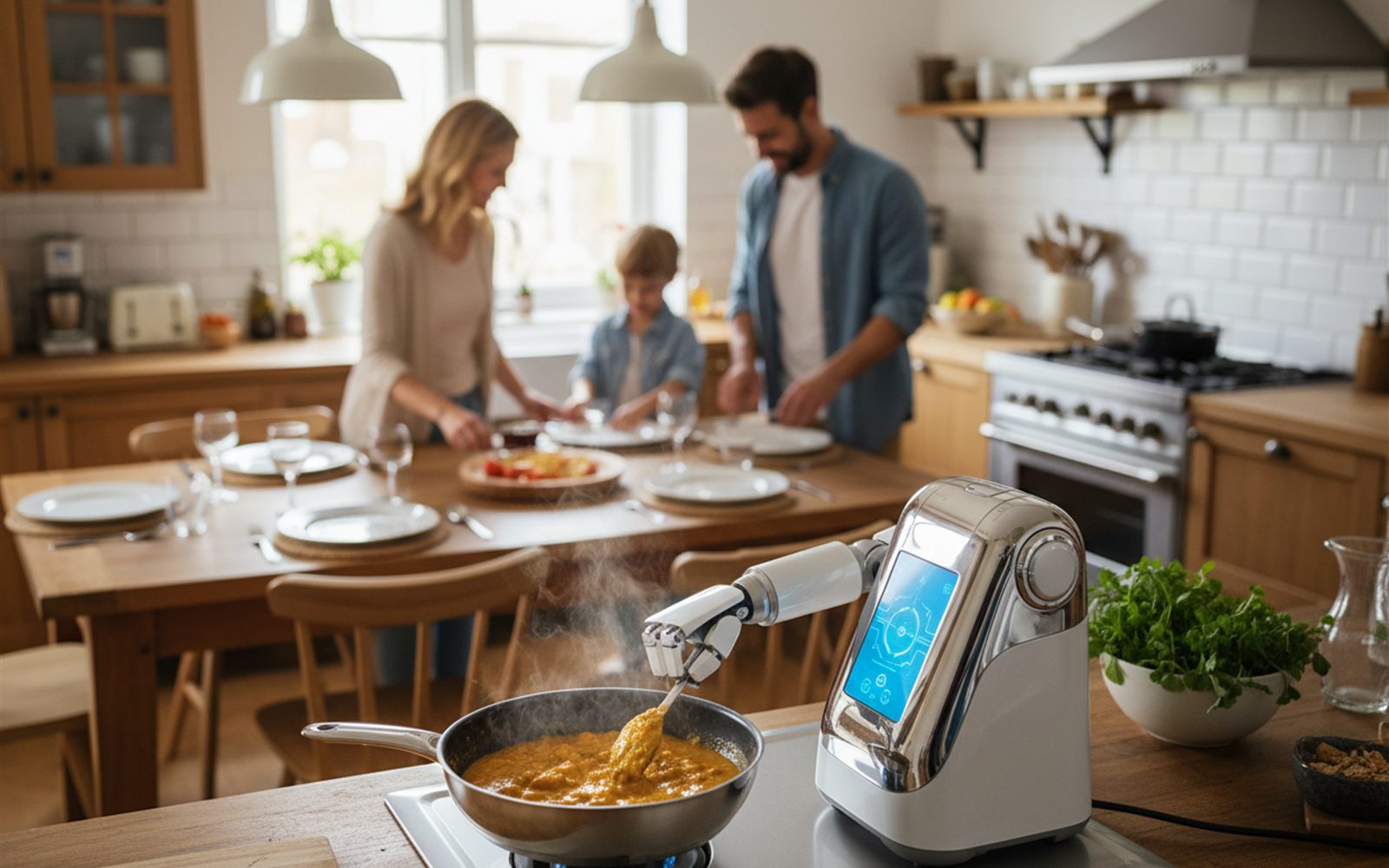
The most useful robot in America does not walk, talk, or look like science fiction. It sits on a kitchen counter, stares into a pan, and keeps stirring so dinner does not burn while you deal with homework, laundry, or your inbox.
A Silicon Valley startup called Posha sells a countertop robot that cooks complete dishes from chopped ingredients. You load the ingredients, pick a recipe on its screen, and the machine dispenses, stirs, and adjusts the heat on its own. TechCrunch reported that Posha sold out its first production run after launching in January 2025, and new units now go for about $1,750.
The interesting part is how it cooks. Posha watches the food with cameras, tracking color, texture, and even bubble patterns, and the company says its training library holds five million data points on how dishes change as they cook. It recognizes when onions turn golden and when a sauce has thickened, the way an experienced cook does with a glance.
Ovens grew eyes too. Samsung’s Bespoke AI oven uses an internal camera to recognize dishes, suggest the right mode, temperature, and time, then stream the inside of the oven to your phone. GE Profile’s CookCam does a similar trick through its SmartHQ app, watching food as it cooks. And at CES 2026, Samsung announced appliances built around Google’s Gemini AI, so the kitchen is only getting more observant.
Cameras and sensors feed a model trained on thousands of real cooking sessions. The machine compares what it sees against what done is supposed to look like, then nudges the heat, the stirring, or the timer. It is pattern recognition, pointed at a pan. The mechanism is worth repeating at dinner: the camera is the chef’s eye, and the software is its patience.
Owner reviews and hands on coverage sketch the same Tuesday evening, so here is the shape of it. At six, you spend your ten minutes: pull ingredients from the fridge, chop what needs chopping, load the machine’s containers, and tap tonight’s curry on the screen. Then you leave. The robot heats the pan, drops in ingredients at the right stages, stirs constantly or occasionally depending on the dish, and watches the whole time, holding the sauce at a simmer instead of a scorch.
The forty minutes you used to spend parked at the stove happen without you. Reviewers consistently describe that stretch as the entire point: homework gets checked, laundry moves, and dinner still lands hot. Busy parents in early owner coverage talk about the machine like a household member, with one describing it simply as a “new best friend.”

The honest boundaries show up by night three. These machines shine at stovetop food, curries, stir fries, pastas, and soups, and do not bake, grill, or deep fry. You still clean the pan and containers afterward, and the robot claims a serious chunk of counter. The trade is clear once you live it: the robot does not remove cooking from your life, it removes standing there.
Reviewers who kept score frame the buying question the same way, weighing the consistency and the reclaimed evenings against the price, the cleanup, the recipe list, and the counter space. Households that rotate the same ten stovetop dinners keep landing on yes, while occasional cooks tend to conclude the takeout app is still cheaper.
The stove no longer needs a babysitter. Start a curry, a dal, or a stir fry and walk away. The part of cooking that chains you to the kitchen is exactly the part these machines took over.
Burnt dinner gets rare. A camera oven pings you at golden brown instead of waiting for the smoke alarm to weigh in.
The weeknight math changes. Early Posha coverage describes roughly ten minutes of hands on work for meals that used to eat an hour.
If robots can cook, why does every kitchen not have one? Mostly because the phrase covers five very different machines at five very different prices.
| The machine | List price | What it actually does |
|---|---|---|
| Tovala Smart Oven Pro | About $349 | Scans meal kits and packaged food, then cooks them on autopilot |
| Suvie 3.0 Plus | About $800 | Refrigerates your loaded meal, then starts cooking on your schedule |
| Thermomix TM7 | $1,699 | Guided cooking, it weighs, chops, heats, and stirs while you follow steps |
| Posha | About $1,750 | Fully cooks stovetop dishes from loaded ingredients, camera supervised |
| Robot arm kitchens | Six figures | Chefee and Moley install literal robotic arms, luxury builds only |
The ladder matters more than any single rung. A Tovala automates dinner if you accept its meal kits. A Suvie shifts cooking to your calendar. A Thermomix makes you a faster cook but keeps you in the room. Posha is the first rung where you genuinely leave the kitchen, which is why it gets the robot label. And the arm kitchens above it prove the ceiling: full automation exists, at prices that make a $1,750 countertop box look sensible.
Who should skip the whole ladder? Anyone whose dinners live on a grill, a sheet pan, or a cutting board of raw salads, since the robots’ sweet spot is the saucepan and the wok. And if cooking is the hobby that keeps you sane, keep stirring. These machines rescue the nights when cooking is a chore, not the ones when it is the best part of the day.
The counter is getting crowded with this kind of quiet help, sitting right beside gadgets like countertop farms that grow your herbs.
The worries here are real enough to deserve plain words.
The first is skill. Writers at Smithsonian Magazine and Fast Company have both chewed on the same question: cooking is one of the last daily crafts most families practice, and a generation that outsources it entirely may lose something cultural, not just practical. The counterpoint from actual owners is that the machine took the stirring, not the cooking. You still pick recipes, shop, season, and chop, the parts where taste lives.
The second is the generation gap in trust. In consumer research reported by FarmWeek, 62 percent of millennials said they were interested in food prepared by robot chefs, while only 39 percent of baby boomers agreed. Respondents named hygiene at 58 percent, consistency at 56, and speed at 54 as the top perceived benefits. The machines are arriving fastest in the households that already trust them.
The third is work. Restaurant cooking sits high on every automation exposure list because so much of it is predictable, repeatable physical routine, and commercial kitchens are adopting robotics far faster than homes. That transition lands on real cooks, and it is the part of this story with no cheerful spin.
And yes, all of this runs on cameras in your kitchen. A lens pointed at a pan is harmless in itself, but it puts the usual smart home questions, what is recorded and where it goes, right next to the stove. Asking a maker how footage is handled before buying is fair play.
You still do the chopping, since Posha cooks from prepped ingredients, and it makes one dish at a time. At about $1,750 plus an optional $15 monthly membership, it also costs a lot of takeout nights. Camera ovens recognize dozens of common dishes, not everything you can bake, and the smartest models sit at the premium end of the price list. This is help, not a full chef replacement.
Posha sells in preorder batches announced on its site. Samsung and GE Profile camera ovens are already in appliance showrooms, and food recognition keeps spreading down both lineups. As always happens with camera chips and software, expect the smart parts to get cheaper fast. By 2028, the reasonable expectation is not a humanoid chef but a stove that simply refuses to burn things, built into ordinary appliances at ordinary prices.
The kitchen robot revolution does not look like a humanoid chef. It looks like a pot that never scorches and an oven that knows exactly what a finished roast chicken should look like.
Meta's new $299 frames and its display glasses turned a nerdy experiment into the gadget of the year.
After a decade of promises, solid state cells are shipping in a real vehicle, with earbuds and cars next in line.
EarFun's Clip 2 puts live translation in 100 languages on your ears without a triple digit price.