
Why Everyone Is Suddenly Wearing AI Smart Glasses
Meta's new $299 frames and its display glasses turned a nerdy experiment into the gadget of the year.
See through screens jumped from trade show stunt to store shelves, and the price curve is finally bending.
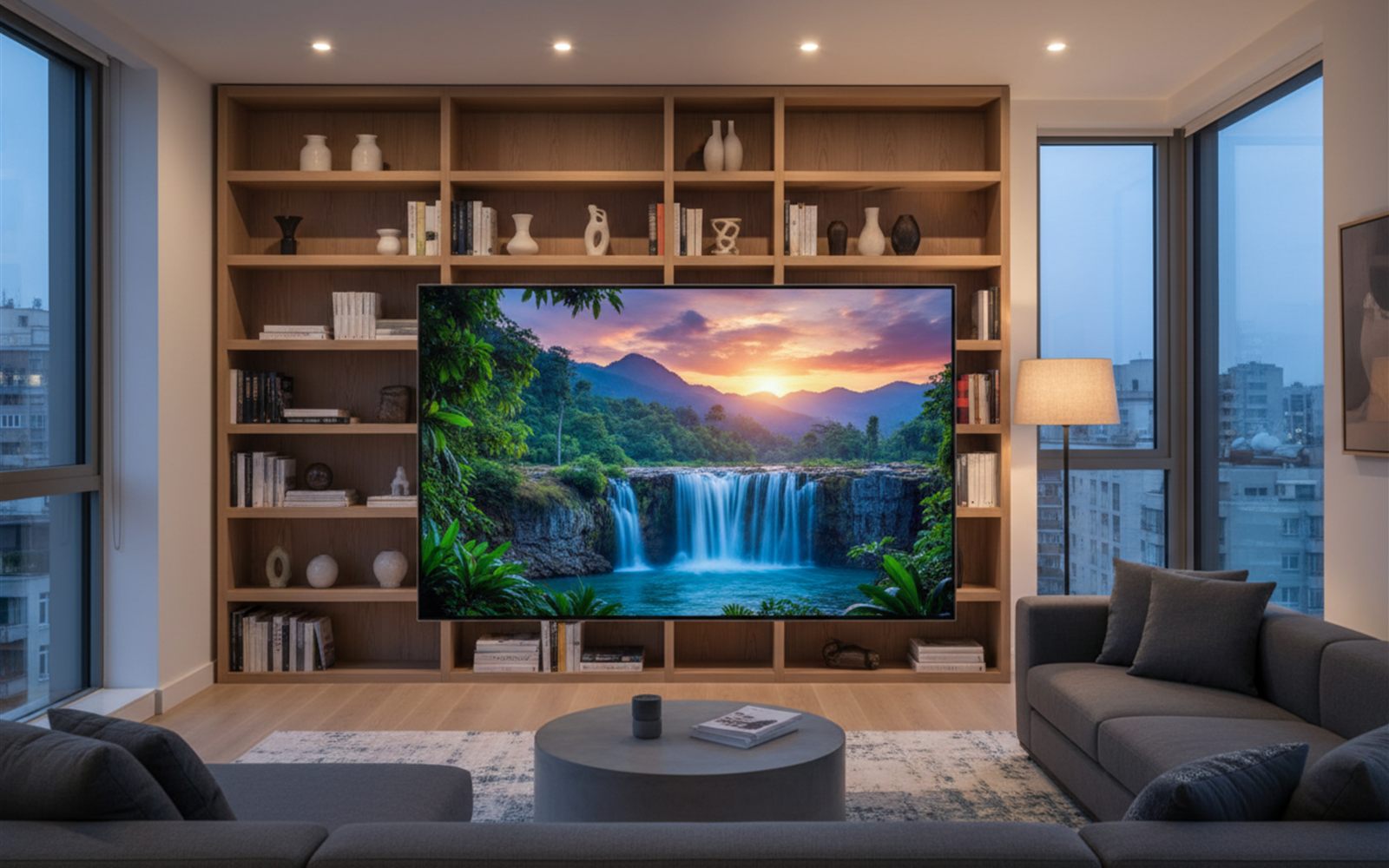
Turn most TVs off and you are left staring at a big black rectangle. Turn off LG’s newest flagship and it nearly vanishes, leaving a pane of glass with your bookshelf visible right through it. That trick is no longer a trade show fantasy.
LG’s 77 inch Signature OLED T, the first transparent 4K TV sold to regular consumers, is available at select LG authorized retailers for $59,999. It first wowed crowds at CES in January 2024, then took nearly a year of engineering before reaching actual stores. It receives video wirelessly from a Zero Connect box, so no cable clutters the see through look, and a contrast screen can rise behind the glass to turn it into a normal, deep black OLED for movie night.
Samsung is chasing the same idea with different hardware. Its transparent MicroLED, an 83 inch panel that makes content appear to float in midair, was named a CES 2026 Innovation Award honoree. It remains a prototype with no ship date, and for scale, Samsung’s regular MicroLED, the kind you cannot see through, already costs $150,000 at 114 inches.
OLED pixels make their own light, with no backlight behind them, so the space between pixels can be genuinely clear glass. Pictures seem to hang on a window. When you want full contrast, LG’s set raises a black layer behind the panel, like blackout curtains for your TV.
Everyone who has stood in front of one describes the same double take. In transparent mode the picture appears to float in midair, a movie hanging in the middle of the room with the shelves and windows still visible behind it. Hands on coverage from CNN Underscored and Trusted Reviews came away impressed by exactly that floating effect, and reviewers who watched LG’s aquarium demo, fish drifting across a clear pane of glass, called the 3D depth of it “incredible.”
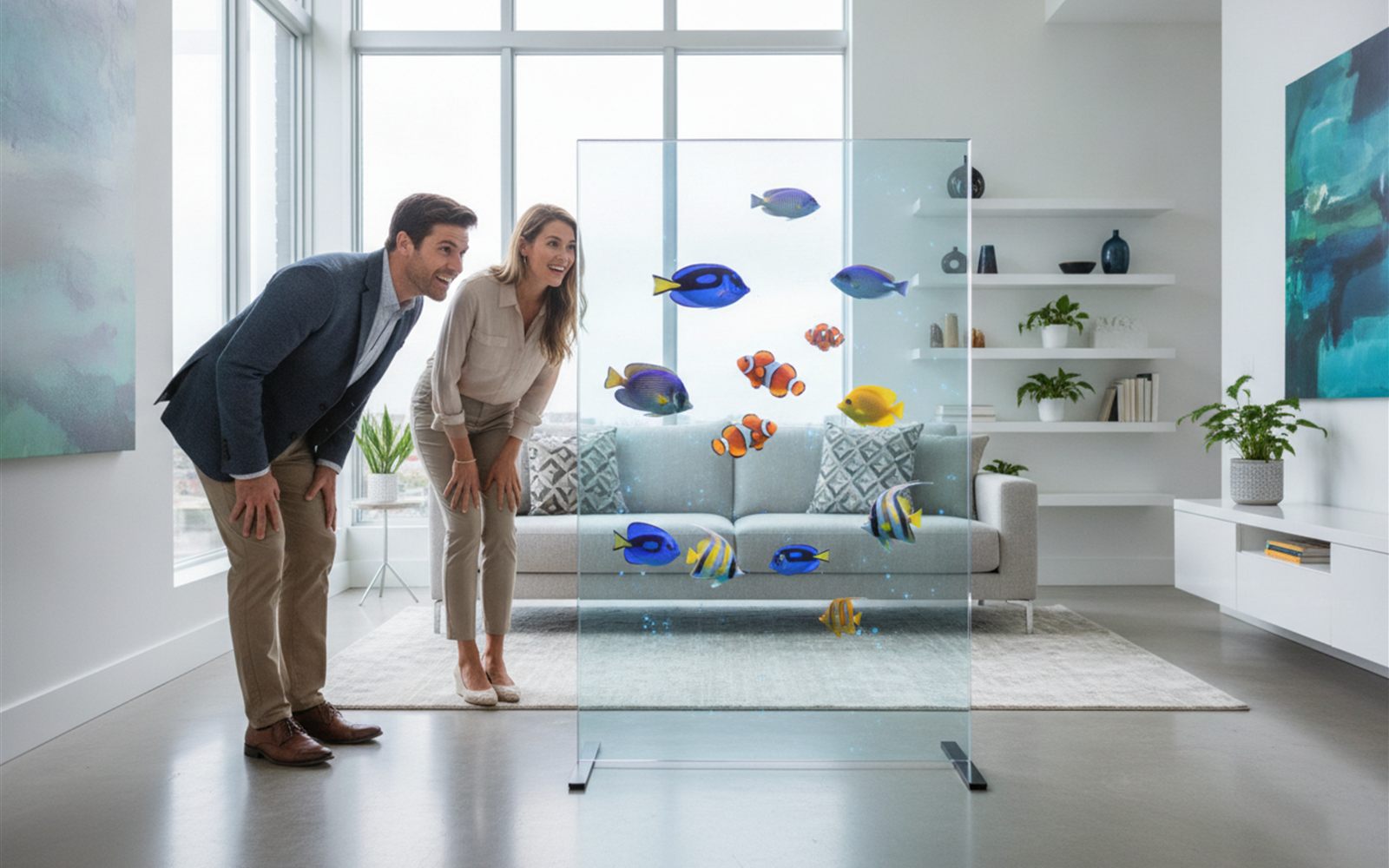
Placement is the practical surprise. Because the off state is clear glass, the OLED T can stand in front of a window or work as a room divider, two spots that would be ridiculous for a normal television. LG leans into that with ambient art scenes and floating info panels, so the pane earns its spot even when nobody is watching a show. And since video arrives wirelessly from the Zero Connect box, the only cord is power, part of the same decluttering wave that wants to beam even your charging through the air.
For actual movie night, the contrast film rises and the glass becomes a conventional deep black OLED. That switch matters, because early viewers were split on watching regular shows in transparent mode. Several reviewers who loved the demo still wondered out loud whether transparency stays a party trick, which is an honest note to carry into a $59,999 decision.
There is a culture story running underneath all this, too. The OLED T’s debut was the talk of CES 2024, with Tom’s Guide readers framing the show as a contest LG might have just won and TechRadar casting the wireless transparent set as LG taking the fight straight back to Samsung. That rivalry is worth rooting for, because two giants racing in public is historically how a showpiece feature falls down the price list and lands in normal homes.
The TV stops being the room’s black hole. Off means invisible, not a dead mirror dominating the wall.
Transparent mode is its own show. LG’s set can run art, ambient scenes, and info panels that appear to hover in front of the room instead of sealing it off, which is why designers love the thing.
And the price direction is your friend. FlatpanelsHD reports that a standard 65 inch OLED panel cost about $1,000 to produce in 2020 and was headed under $500 by the end of 2025. Commercial 55 inch transparent OLED modules that once cost far more now sell for around $3,400. Screens ride that curve, and showpieces become normal.
Here is the paradox of the moment: a see through TV costs $59,999, yet most people who want a disappearing screen this year will spend about $2,000 instead. That is because there are three roads to the same goal, and only one of them requires glass pixels.
| The option | Price today | How it disappears |
|---|---|---|
| LG Signature OLED T, 77 inch | $59,999 | The screen itself is clear glass |
| Samsung transparent MicroLED, 83 inch | Prototype, no price yet | Floating picture on glass, with brighter MicroLED pixels |
| Ultra short throw laser projector | Roughly $1,700 to $3,500 | The picture switches off and the wall goes back to being a wall |
The projector route is the sleeper. Ultra short throw models, often marketed as laser TVs, sit inches from the wall and paint a 100 to 120 inch picture. Projector Reviews’ 2026 roundup puts strong performers like the Formovie Theater, Hisense PX3 Pro, and XGIMI Aura 2 in the $1,700 to $2,500 band, with Epson’s bright LS800 at $3,499 and Leica’s badge heavy Cine 1 near $9,000 for people who want a luxury version anyway.
The projector’s honest weakness is daylight. Even bright laser models look their best with the blinds partly drawn, while an OLED shrugs at a sunny room. If your living room is a fishbowl of windows, weigh that before falling for the price tag.
So who should pick which? If the money is genuinely trivial and you want the object every guest asks about, the LG is the only transparent set you can actually buy. If you want the biggest vanishing picture per dollar, an ultra short throw projector wins and it is not close. And if you want transparency plus serious brightness, that is Samsung’s pitch, but it ships on no announced date at a price that, judging by its $150,000 regular MicroLED, will sting.
If the price feels absurd, remember that every OLED price once did. LG’s first 55 inch OLED reached American stores in 2013 at $12,000, and tech press including Computerworld tracked the first 4K models arriving around $9,000 to $11,000 the following year. In 2026, Tom’s Guide routinely flags 48 inch OLED deals under $600. Same core technology, roughly 95 percent off, in 13 years.
Transparent screens have a head start on that slide, because commercial buyers are funding the factories. A 55 inch transparent module that sells to shops for about $3,400 today is the early rung of the same ladder, and FlatpanelsHD’s falling panel production numbers earlier in this story are the engine underneath it, since the panel is most of what a TV costs to build. History is not a promise, but the pattern is one of the most reliable in consumer tech: the showpiece price is not the real price, it is just the first one.
That points to the practical play for most households: buy the picture you need today, and let the people paying $59,999 fund the factories. By the time transparent panels reach four figures, the brightness and contrast compromises will have been engineered down on someone else’s budget, which is exactly how the first decade of regular OLED played out.
$59,999 is a car budget, not a TV budget. Transparent panels also give up some brightness and contrast while you can see through them, which is exactly why the retractable backing exists. And for now most transparent displays are sold to stores, hotels, and museums rather than living rooms. Analysts size the transparent OLED market at about $2.9 billion in 2026, and the bulk of it is commercial.
Expect the disappearing screen to spread the way flat OLED did, penthouses and hotel lobbies first, then premium living rooms as factories drive panel costs down year after year. LG Display already sells transparent panels for shop windows and metro train cars, the commercial volume that keeps those factories humming while home prices fall. Samsung’s award winning prototype signals that every major TV maker sees the same endpoint, a screen that only exists when you want it to.
The most impressive thing a 2026 television can do, it turns out, is disappear.
Meta's new $299 frames and its display glasses turned a nerdy experiment into the gadget of the year.
After a decade of promises, solid state cells are shipping in a real vehicle, with earbuds and cars next in line.
EarFun's Clip 2 puts live translation in 100 languages on your ears without a triple digit price.